Monday, February 20, 2012

Lions, and Cheetahs, and Buffalo, oh my!

These last 2 months have been a bit of a blur. 

1.  We were in Nairobi, Kenya, for a 3-week missions training course. It was great to meet other families serving throughout the world and to learn about cross-cultural service.  
 
But my mind was often taken back to worrying about the well-being of the Eye Hospital in Lusaka which I had left behind.  Most of our time in Nairobi was spent in the classroom, but we did have 1 and a half free weekends during which we able to venture out and explore the country. 

The first weekend, we took a day tour of Lake Nakuru. We were expecting to see hundreds, if not thousands of flamingos.  But once we got there, we were told by our tour guides that the flamingoes had migrated south to Tanzania for the season and would return in a few months time.  Instead, we'd see lots of pelicans.  Perhaps they should have told us that before we signed up. 

Nonetheless, we enjoyed our time seeing various animals and birds – and even got to see a lioness with her cubs lounging under a tree.  We especially enjoyed watching the antics of the baboons. 

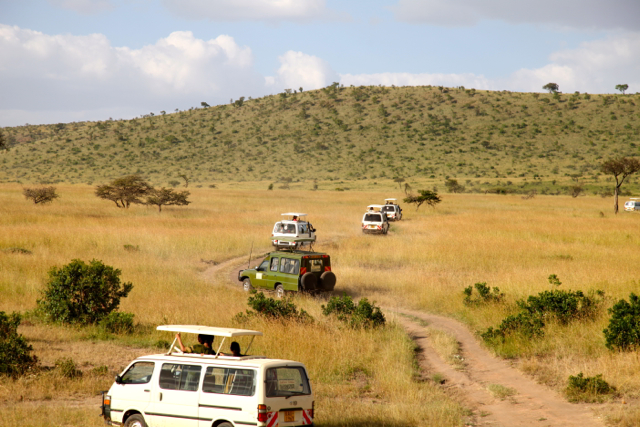
The second free weekend, we piled 20 people into 4 minivans and caravanned on a 5 hour ride to Masai Mara National Park.  

We stayed at the beautiful Sentrim Mara Lodge.  We experienced 4 game drives, and each one was super special.  So many different animals were spotted, including zebras, many varieties of antelope, buffalo, giraffes, elephants, hippos, warthogs, lions, jackals, hyenas, and even a hunting cheetah!  God’s creation is truly magnificent. 
One of the highlights of the trip was getting to sleep in the hotel “tents” at the lodge.  Throughout the night, we heard the howling of hyenas and groans of cheetahs; it was truly an incredible experience sleeping amidst the wild animals.   

For more animal photos, feel free to see the Facebook Kenya album.

2.  We fired our maid.  Although it was sad to lose a good helper, we realized it was just too stressful for us to leave someone alone in our home all day, especially if we were not able to fully trust her.  Hopefully we can find another helper soon. 

3.  We’ve been working with a wonderful Canadian donor, Colin Glassco, to sponsor one day of children’s surgeries every month.  This has been a welcome relationship, in which the neediest patients who cannot afford to pay for surgery have been able to undergo surgeries free of charge on the specific Glassco days.  
 
4.  I had another opportunity to attend another National Prevention of Blindness Committee meeting, specifically addressing the issue of trachoma in Zambia.  It was great to sit with other ophthalmologists, representatives from the International Trachoma Initiative, and country directors of donor organizations like Sightsavers International, CBM, and Operation Eyesight Universal, to discuss the problem of trachoma in Zambia and figure out ways to tackle the issue.

5.  Last week, Zambia made history!  Zambia won the African cup of nations (soccer) for the first time in a close match against Ivory Coast!  The whole country was in a state of celebration. 

6.  I was on local television twice!  Although I never saw the news report, nor do I receive “Muvi TV” on my television set, I have heard that the interviews were aired.  Unlike American TV shows, which are taped weeks ahead of time, edited, and then finally aired, Muvi TV and other local African channels tape and air shows on the same day.  The whole situation came about because a small baby with sclerocornea had parents who were very proactive in finding a sponsor for their child’s corneal transplant.  They sought out a TV channel and were interviewed by Muvi TV.  On television, they explained their plight – they did not have the finances to fund a corneal transplant.  A local Lions Club approached me and asked if they would partner with me in helping this baby undergo surgery.  We agreed and set a date for the surgery.  Muvi TV interviewed me and the patient’s family preoperatively, and that was aired a month ago.  Last week, Muvi TV came to film the actual surgery and another interview.  Apparently, this, too, was aired last week.

WARNING!  Please stop reading now if you are averse to seeing my eye photos.

7.  Another batch of corneas arrived!  
Midwest Eye Banks was able to send another set of fresh corneal tissues, so I did 5 transplants last week.  

Patient #1 was the sclerocornea baby.  She was 2 years old and responsive only to light in both eyes since birth.  
 I performed the corneal transplant in the right eye, but not with a struggle.  As soon as I opened the eye, I realized the iris and lens were stuck to the cornea.  I had no choice but to remove everything and to leave the child aphakic.  The process of sewing a graft onto the squishy 2-year-old’s sclera was akin to sewing together two soft, rotting grapes.  But somehow I managed to close the globe.  
 

And somehow, the next day, the child was able to track my finger with her new eye!  Her parents were delighted that she seemed to be "seeing" for the first time.  She was very sensitive to light, so most of the photos I snapped of her captured the back of her head. Here's one blurry shot of her face.
Patient #2 was a 43-year-old man with Mooren’s ulcers.  His left eye was essentially hopeless, with iris bulging out and no real corneal substance left to support the globe.  We had scheduled him for an evisceration.  However, his right eye seemed to have some slight hope.  He had pockets of iris pooching out in 3 places inferiorly.  There was only a small area of firm cornea intact superiorly.  
I realized the only way to help him was to perform a large-diameter graft.  Although it was difficult to find and clean up a firm area on the inferior sclera onto which to anchor the donor corneal tissue, after much intraoperative prayer I managed to close the eye.  And although his inferior iris was chopped off, fortunately his lens remained intact.  
He was my happiest patient on postoperative day #1.  He was able to see CF@2 meters and was finally able to walk around on his own without being led by the hand.  
Patient #3 was a 28-year-old girl who was phthisical in her right eye and had a dense corneal scar in her left (HM vision).  I was not too clear about her visual prognosis, but we agreed to attempt surgery.  
Fortunately, her lens was not cataractous, so I left it intact.  Also, the iris was only adherent to the cornea inferiorly, so I was able to leave the superior part intact.  

Postop day #1, she was able to CF@1.5 meters and slowly walking around on her own.  She seemed pleased with that.  
Patient #4 was the mother of one of our hospital employees.  She had been blind in both eyes for quite some time, and both corneas were very swollen.  Again, knowing the guarded visual prognosis, I did not guarantee any promise of success.  

Intraoperatively, her iris and lens were in no state to keep, so I was forced to cut them out with scissors.  What was left of the lens was really a fibrosed lens capsule, as there was no evidence of a crystalline lens anywhere to be found.  My heart sank when I realized that leaving her aphakic was my only option.  Nonetheless, I sutured up the eye and prayed for the best.  

On postop day #1, her cornea was very swollen, and her vision was no better (HM preop, HM postop).  Hopefully, she’ll get some improvement once the corneal edema and vitreous heme subside.  Only time will tell. 

Patient #5 was supposed to be my slam-dunk patient.  She was a 20-year-old female with keratoconus of both eyes – large Vogt striae across the middle of her corneas and central corneal scarring.  

She wore hard contact lenses, and her best vision with those lenses was 6/36 in both eyes.  Without glasses or contacts, she was CF@1 meter.  She was quite myopic with some astigmatism, so I decided to oversize the donor cornea only 0.25 mm larger than the host bed (instead of the usual 0.5 mm) to give her some corneal flattening.  That was my first mistake.  My second mistake was to re-use an autoclaved trephine to cut the donor tissue.  An incomplete cut required a manual completion using corneal scissors, resulting in a slightly irregular edge for ¼ of the donor tissue perimeter.  These factors combined led to a 2 hour surgery in which I struggled to close the eye.  It just kept leaking and leaking, and I kept adding suture after suture.  Instead of my normal 16 suture transplant, I ended up placing 27 in this poor patient.  Finally, after what seemed like eternity, I managed to close the eye enough to hold a chamber.  

But somehow, miraculously, on postop day #1, despite her significant corneal edema, she was seeing 6/36!  

There are so many times that the Lord has made up for my deficiencies due to my complications in less than ideal surgical situations with less than ideal equipment/microinstruments.  I praise God that despite my inadequacies, He covers so many of my mistakes and helps my feeble efforts as I do my best to help my patients. 

Tuesday, January 10, 2012

A Package Worth Waiting For

Last week, I had one of the nicest packages come in the “mail.”  No, it wasn’t a surprise gift from my husband.  No, it wasn’t even a big care package filled with yummy treats from the U.S. It was a box, a large Styrofoam cooler, with ice inside, and 5 precious fresh corneal tissues.  The dates of death were December 22 and December 24.  The endothelial cell counts were between 2200 and 2500.  And they were gorgeous in my sight.  
Since I arrived in this country of Zambia, I have been on a quest to find a steady source of fresh corneal tissues.  My cornea transplant list continues to get longer and longer and longer by the day…by the minute.  As word has been getting around that I am doing transplants, patients have been coming to Lusaka Eye Hospital for evaluation.  There have been patients who have been on a corneal transplant wait list for years, and I am insisting that they come in to see me for an evaluation before we ultimately decide to put them on my final transplant list.  

These particular tissues arrived in Zambia due to the generosity of Midwest Eye Banks.  They had a few surplus tissues from the holidays, which they were able to provide for a minimal fee.  So, who were the recipients of these 5 corneas? 

1. A tall, slender, humble 39 y/o male with h/o HIV who is completely blind in the left eye due to some AIDS-related retinopathy presented to my clinic with a right corneal perforation plugged with uvea, dense central corneal haze, a cataract, and hand motions vision.  
I told him he probably needed a PK triple (corneal transplant + cataract surgery + intraocular lens implantation), but as I didn’t have fresh tissue at the time, I told him the best we could do was stabilize the cornea with a glycerol transplant and try to obtain fresh tissue in the future.  He was so discouraged that he went to another ophthalmologist for a second opinion.  That ophthalmologist sent him back to me, recommending a corneal autograft from the left eye (taking the perfectly good cornea from the blind left eye and transplanting it into the right eye), but I wasn’t convinced I wanted to do surgery on both eyes, especially as the right cornea had a big hole in it.  Fortunately, a few days after the patient returned to my office, I was notified that Midwest Eye Banks was sending some fresh corneal tissues.  We phoned him immediately and told him the good news.  The PK triple went uneventfully, thank goodness.  

 Me in the OT ("operating theatre"), as they call it here
 

Open sky cortical removal with a Simcoe needle

POD#1: The nurse who removed the patch told me, “I wish you had removed the patch yourself.  He was so excited!”  She reported that he kept saying, “I see light,” and looking around in wonder that he could see.  His VA was CF @1 meter.   

Today (POW#1), his vision was still CF @1 meter, but he states it is improving.  At least he can now walk around on his own without being led by the hand.

2. This 34 y/o nun had severe keratoconus in both eyes since she was 5 or 6 years old.  Her left eye had been operated on previously and now was seeing quite well.  I promised her nothing, due to the possibility that she might have amblyopia, but she wanted to proceed with corneal transplantation.  Preop VA: CF @1 meter.   
POD#1: VA was CF @2 meters.
POW#1: again, VA was stable at CF @2 meters.  The graft looked good.  We'll have to wait to see if any more vision comes back.  She was so excited to see the photo I snapped on my digital camera of her transplant today. 

3. The third patient was a 49 y/o man who had a cataract and a central corneal scar of the right eye.  His pupil was eccentric even prior to surgery.  His PK triple was complicated by vitreous loss, so an anterior vitrectomy was performed.  The IOL was stable in the sulcus.  Preop VA: CF 3 meters.   
POD#1 & POW#1: VA CF @1.5 meter.  Hopefully, once his corneal swelling goes down, he'll get some vision back.


4. This 38 y/o woman had history of measles keratopathy of both eyes.  VA in the right eye was CF @ 1 meter (but only from a small temporal window).  VA in the left eye was essentially nonexistent. Although I didn’t guarantee anything for her right eye, I sincerely hoped that this transplant would help.  

POD#1: VA stable at CF@1 meter (temporally).   
POW#1: VA was improved to CF @3 meters (temporally).
5. The last patient was a 17 y/o girl in her first year of University.  She had keratoconus and recently was treated by me for acute hydrops of the left eye.  Her corneal edema eventually subsided, but she remained with a horrible central scar.  Preop VA: CF @2 meters (she had even gone down to Hand Motions vision during her hydrops episode).  


POD#1: 6/36!!!  She was too sensitive to light for a photo that day.  I’ll be seeing her for follow up in 2 days, and I am praying that she does well.  
 
I thank God for these 5 fresh tissues.  Now that I’ve used all of these successfully, my only other question now is: how and when can I get more? 

Saturday, December 31, 2011

Cars, cars, cars

I once came across a blog entry describing the 50 steps required to obtain a Zambian Driver’s License. They weren’t kidding!  When I first read the blog entry, it struck a funny bone because I knew that it was quite possible that such a straightforward, mundane activity could become such a huge ordeal in Africa.  I realize that for a Zambian with all the time in the world, this might not be such an unusual process.  However, for someone who is busy, has a full time job, and is so dependent upon others to get anything accomplished while getting settled in a foreign land, it has turned out to be an incredibly frustrating and bewildering process.  From going to get our health exam, then going to one RTSA (Road Transport and Safety Agency) office, standing in lines, being told to go to another window, then standing in more lines, then going to another office…to being told that we need one form or another document or that we are too late for the practical driving test and that we need to return tomorrow…it has been quite the ordeal.  There are never clear instructions as to what steps need to be done in what order, what offices need what documents, how much to pay when or what the rules of the game are.  We actually had the assistance of a local who guided us through the whole process, but even then it was difficult.  And it wasn’t free.  Imagine if we had attempted to undergo this process alone!  I don’t think we would have survived. 

Nonetheless, we were able to jump the final hurdle this week.  Both Paul and I underwent our practical driving test under the scrutiny of the RTSA examiner.  One tip that was given to me just before we started off was, “Don’t cross your hands on the steering wheel while making a turn.”  It is a strange rule they have here in Zambia, but I succeeded in driving like a granny during those short 7 minutes on the streets of Lusaka.  It’s quite awkward…harder than it seems (you should try it sometime!).  After all was said and done, Paul and I both got a “Pass!”  =)  We even obtained our Temporary License, so in 2 weeks we should have the actual License in our hot little hands. 

Timing has been good, since we were told that our new car had arrived at the dealership this week (we had ordered it 2 months ago, but it had to be built in South Africa).  So just after our driver’s test, we were able to go to the local Toyota dealership and pick up the vehicle.  To tell you the truth, it nearly emptied out our U.S. bank account.  But since our commitment here is for 6 years, we wanted to have a reliable, sturdy vehicle suited for the African terrain which would also have a good resale value.  She is a beauty.  We look forward to many trips and adventures exploring Southern Africa in this strong but sleek 4x4.  


Sunday, December 25, 2011

Hakuna Matata

After two days of traveling, we have finally arrived back home in Zambia.  It still feels a bit awkward to call Lusaka “home,” but it really does feel nice to be home.  Our week in Zanzibar, a beautiful island off of Tanzania, was both refreshing and therapeutic.  After 4 months of battling major stressors like picking up and moving to a different country as well as encountering countless frustrations in struggling to understand a culture opposite from one’s own, we decided we needed a quick get-away to relax and calm our minds.  And this was quite the get-away.
We stayed at a beautiful hotel sitting along the northern coast of the island (Nungwi).   
The white sand beaches and crashing waves created an idyllic scene as we soaked in the infinity pool, relaxed beneath the umbrellas, and ate breakfast from the beachfront restaurant overlooking the Indian Ocean.  

With 98% of the population being Muslim, most people dressed their part in conservative yet colorful clothing despite the sunny beach atmosphere.  
The sing-song chants of the frequent prayers were heard throughout the day.  The locals spoke Swahili, so the common phrases “Jambo” (hello) and “Hakuna Matata” (no worries) were often flung our way.  Tourism, fishing, and spice farming seem to be major industries on the island, and the women would daily walk to the shore with big buckets, hoping the fishermen would come back from a good catch with thousands of tiny silver fish.  When the tide was out, the women would wade into the water with their full garb.  
Children would play their part in helping contribute to the daily earnings. 
Stonetown was an interesting place, with a lively mixture of outdoor markets, mosques, artwork, and shops.  
We saw many different shapes and designs for doors.  Many had spikes protruding from them, which were intended to thwart off elephants.

The narrow roads were frequented by bicycles and scooters zooming past the pedestrians.  
Although Zanzibar is mostly Muslim, it’s a very peaceful place, and the Christian church seemed to coexist just fine next to the mosque.
The highlight of our trip was the opportunity we had to learn to SCUBA dive.  We ventured out into the hotel pool, then out into the open sea to learn the basics of diving down to the depth of 50 feet.  What a thrill it was to learn to breathe underwater, to feel weightless and neutrally buoyant in the Indian Ocean, and to admire the whole new world of sea vegetation and God’s wonderful ocean creatures on our exhilarating open water dives.  Now that we’re PADI-certified for open water diving, we hope to get more opportunities to explore the underwater world throughout the world.  Hopefully by then we’ll have an underwater camera.
Another highlight was meeting Conchester, a local masseuse, who induldged us with an hour long massage session each day for 4 consecutive days.  I also enjoyed reading some books from the Reading Room.  We certainly got our R&R this holiday season.  
Now back to reality.

Sunday, December 11, 2011

December update

The last few weeks have been a blur of activity.  Here’s are a few snippets of what our lives have been like in the last 2 weeks:

1.    I’ve had some variety of viral sickness that has migrated from one part of the body to another – causing a sore throat, generalized malaise, then a runny nose (but, strangely, only the right nostril), then a congested eustachian tube (I’ve suffered from decreased hearing out of the right ear for the last two weeks), a week of loose stool, back to a sore throat, then nasal congestion.  I’m almost back to normal, but I still can’t hear properly! 

2.   My role has changed suddenly and dramatically at the Lusaka Eye Hospital.  As of November 29th, I’ve officially been named the Medical Director and Administrator of the Lusaka Eye Hospital.  This has meant that all of a sudden I am in the position to make important decisions for the running of the institution and managing the 42 employees on payroll.  Although I feel inadequate for this position, I know it is not by chance that all of these changes have occurred.  I just hope and pray that I will be able to help lead this hospital in the right direction (and hopefully out of the red). 

3.   Dr. Mumba has left Lusaka Eye Hospital for greener pastures.  He’s served as the ophthalmologist here for the past 3 years, and we appreciated his years of service.  We bid farewell to him with a simple party and cake.
 
4.   LEH’s 10th Anniversary.  November 2011 marked the 10th anniversary of the Hospital’s birth.  We had a celebration and ceremony, characterized by a PA system that wasn’t functioning properly, a tacky blue and white tent, and many awkward moments on stage.  Nonetheless, it was a happy occasion to celebrate the decade of eye care service this hospital has contributed to the people of Zambia.

5.   By virtue of my appointment to a position of leadership at my Eye Hospital, I was at the last minute invited to attend Zambia’s National Prevention of Blindness Committee Strategic Planning meeting.  So for three full days I sat in meetings with about 10 ophthalmologists (mind you, there are only 22 ophthalmologists in the whole country) visioning, discussing, and planning the strategic national plan for eye care in Zambia for the next 4 years.  It was a blessing to be able to take part in such a committee and to get a better understanding of the “big picture” in terms of eye care for the country. 

6.   Two weeks ago, we had a chance to visit Riverside Farm Institute for the 3rd time since we arrived in Zambia.  RFI is a self-supporting institution that has a farm, a mill, a school, and a wellness center.  It’s a beautiful area, about 1 hour’s drive from Lusaka, and it’s always nice to hang out and hike with fellow Americans. 

7.   Last week, we had some visitors from the Eastern Province – Dr. Verna Peduche and her husband, Gem, who are missionaries out at Mwami Adventist Hospital.  It was a historic few days, as they were our first set of visitors here in Zambia.  Now that they’ve warmed up the house, we’re now open to more!!!  If anyone wants to visit Zambia, you know where to stay!

8.   We finally bought a car!  For the last 4 months that we’ve been here in Zambia, we’ve had to rely heavily upon others for our mere survival.  Getting to work, coming back to work, going to church, running errands, and buying groceries all involved calling up a driver or begging for a ride.  But as of 2 days ago, we have our own set of wheels!  How liberating it felt to be able to get behind the wheel of a car and drive ourselves to buy groceries!  We even treated ourselves to an Indian restaurant for lunch.  Mind you, the car is old (1996ish Toyota Corolla Saloon), tan, and small, but it will suffice for now.  At least until we get our 4x4 truck. 

9.   We almost fired our helper.  We found that our levels of sugar were being depleted quickly.  Our cooking oil was running low at an abnormally fast rate.  The shampoo we had left in our guest bathroom was newly purchased, but we found that it was almost 1/3 empty.  Our laundry detergent was half empty, and we had only done 2 loads of laundry.  Our dishwashing soap and other floor cleaners were disappearing quickly.  And there were at least 2 rolls of toilet paper missing.  At first, we assumed she was simply being careless and using the supplies without discretion.  But then our suspicions were aroused, and we confronted her.  In fact, we nearly fired her that same day.  But she pleaded for a second chance, so we agreed to keep her on the grounds that she does not take or use any of our supplies or food.  Talking to other locals who have maids, this behavior seems to be the norm rather than the exception.  But what do you do when these lovely people need a job and food so desperately?  We decided to give her a little additional money to purchase food and discourage her from taking our food/supplies.  Hopefully, she has gotten the message and we won't have to fire her after all.  

10. Our garden is slowly growing.  We’ve only eaten spinach from the garden so far, but hopefully the eggplant and other veggies will start to produce soon. 


So that’s it for updates thus far. 

By the way, if anyone feels compelled to send us a Christmas card from the U.S., our address is:

Janie & Paul Yoo
Lusaka Eye Hospital
Post Net Box 674. Private Bag E891
Lusaka. Zambia 10101                 

The mail might take a month or so, but it’ll probably eventually get here.  Unfortunately, we won’t be sending out Christmas cards this year from Zambia. I hope you’ll forgive us! =) 

Happy Holidays!!! 

Wednesday, November 16, 2011

Evisceration + Enucleation

Two weeks ago, a lady came in with a horrible looking corneal ulcer of the right eye.  It was large, necrotic, and causing a great deal of pain.  Her vision was light perceptions only.   

Her left eye was fine.  I started her on frequent antibiotic eye drops, but told her she would likely need a tectonic graft in the near future.  I saw her again last week; the nasty redundant necrotic tissue had cleared slightly, and now I could see that there was a large desmetocele centrally with iris poking forward.  But I had a dilemma.  The only corneal trephines I have are one size (8.5 mm for the donor, 8.0 mm for the host cornea).  I have been attempting to order other sizes from India, but they have been slow in coming.  This lady needed a limbus-to-limbus transplant in order to make this tectonic graft work.  Her ulcer was just way too large.  I told her to come back in 3 days while I tried to find a large trephine. 

Apparently, I was too optimistic about how long the desmetocele would hold.  The next morning, she presented stating that last night she felt a “gush of fluid” and felt like “there was a hole in the eye.”  I knew immediately that she did indeed have a hole in the eye.  And I realized that I did not have the technology or resources to fix her.  I explained to her the imminent need for an evisceration (scooping out the contents of an eyeball), and we proceeded to the operating theatre.  

I haven’t done an evisceration since my residency days, so I felt a little rusty, but the surgery itself went smoothly.  Unfortunately, we don’t have orbital implants available at our facility, so I had to leave the scleral shell empty.  Nonetheless, closure was straightforward and hemostasis was obtained with time and pressure.  

That same day, we also did an enucleation on a poor little 2 year old child with leukocoria of the right eye.   
The week prior, we had performed an exam under anesthesia and determined that she had a large intraocular tumor very suspicious for retinoblastoma.  I had the honors of cutting the optic nerve.  
This globe will be sent to pathology at the University Teaching Hospital in Lusaka, and we will be able to determine whether or not it is retinoblastoma. 
This is probably the driest orbit I have ever seen in an enucleation.  Fortunately, we were able to find a single orbital implant...the only one in the hospital.  But it was a size 20.  It seemed far too big for this young patient, but fortunately for this orbit, it fit perfectly!  

Last week on Monday, I did another glycerol corneal transplant on a patient with another horrible corneal ulcer/desmetocele.
 Although we still don’t have all the supplies that we need (corneal block and trephines are currently on their way from India) and I have to punch the tissue on an eye shield, at least the eye looked intact postoperatively.   


And on postoperative week #1 she was already counting fingers at 1 meter!  Unlike the first patient, she avoided an evisceration,...at least for the time being.